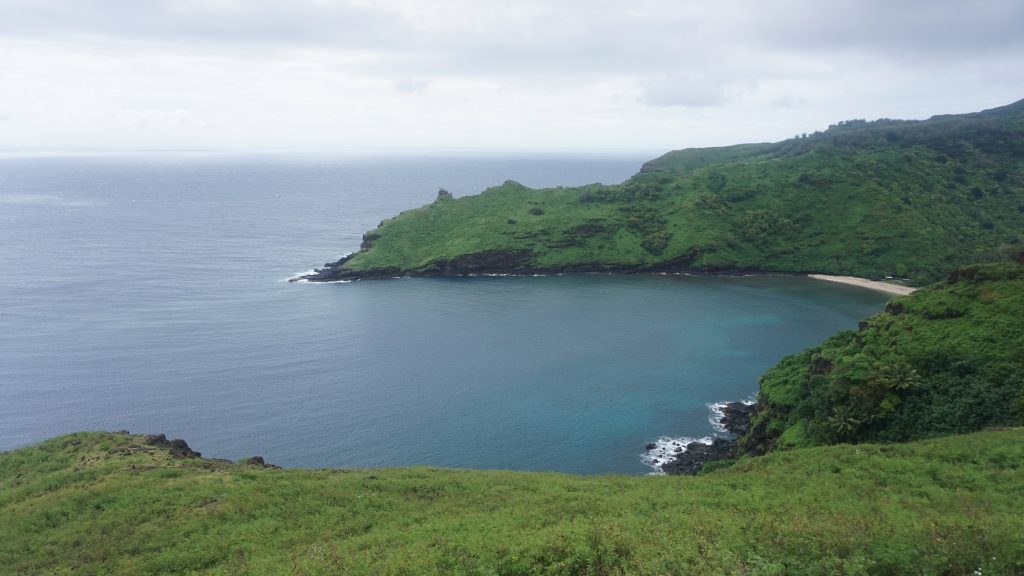
Open post

Half way in Tahiti

Two days from Anse Amyot and we would be in Tahiti, pretty much half way across the Pacific.  I remember thinking back to sailing in the UK when a two day passage was a big undertaking.  Now it was a short haul, and we barely got into a watch pattern before we arrive in Pape’ete, capital of Tahiti and French Polynesia.

[This post was written in September about being in Tahiti in late July – Early August]

This was the first city since Panama in March, and a shock to the system.  As we approached the port, flanked by car-sized marker buoys towards a forgotten shoreline encased with concrete, there was no flotilla of scantily clad Tahitians canoeing out to welcome us as was promised by reading the Mutiny of the Bounty.  But then, that was a couple of centuries ago.

In fact, outrigger canoes were everywhere – extremely fit looking men were paddling them about all over the place, but they were made of glass fibre rather than hollowed out trees.  The landscape was industrial, with refineries, supermarkets and an airport on the seafront, which we had to call on the radio to make sure we didn’t get in the way of any planes taking off.
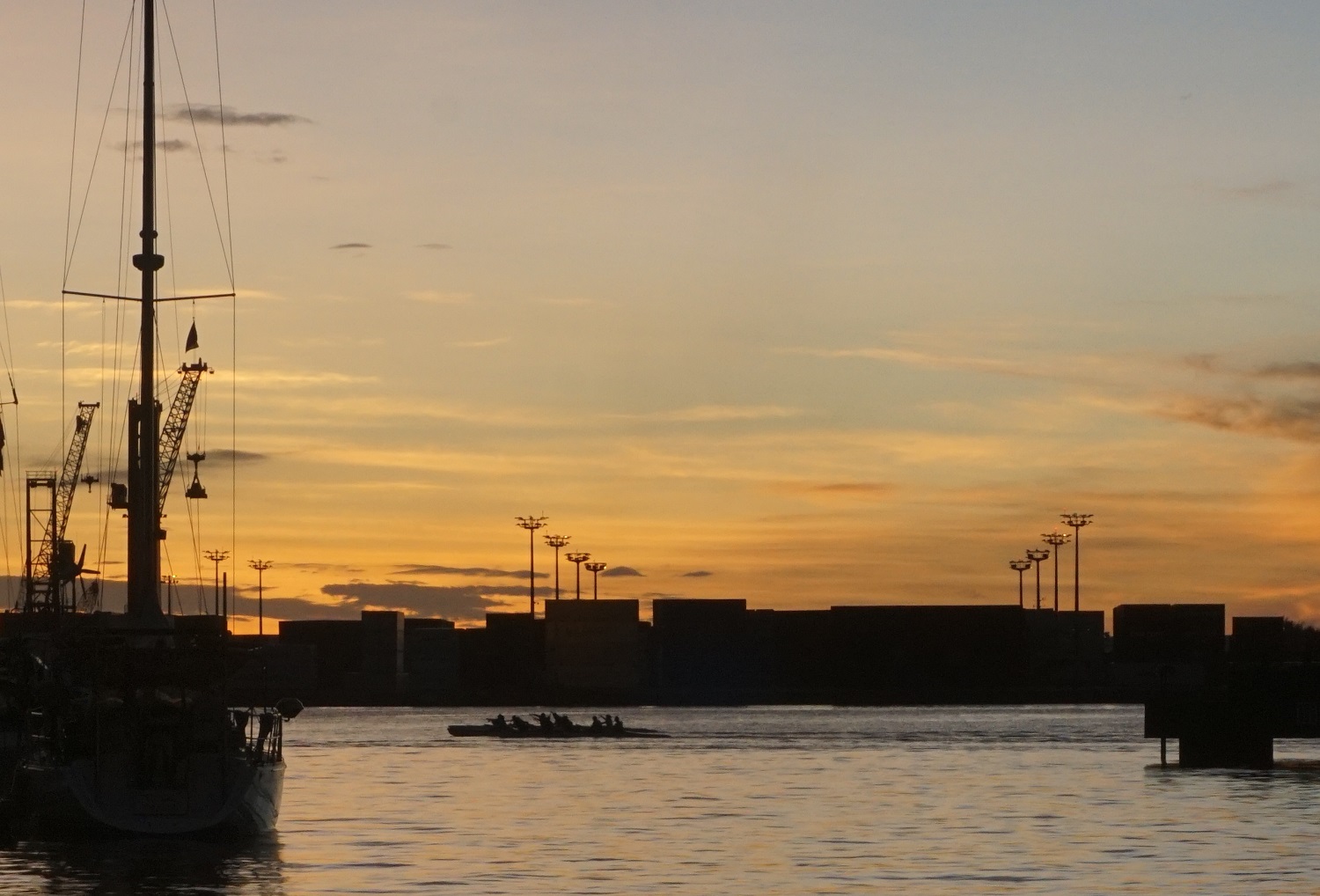
outrigger

After mooring up we went ashore for our first supermarket fix since Panama.  In time I will forget how nice it was to go into a large supermarket that had everything you could possibly want.  Proper bread flour and good cheese were now things that excited me quite a bit.

We had timed our arrival for the Pacific Puddle Jump Rendezvous, a get together of all the cruisers crossing the Pacific from the Americas.  It would be good to swap stories and catch up, but I also wanted to see if there were any other boats I could jump on to that would get me to Australia by the 4th September, which was when my girlfriend, Ell, and I would be driving down to Melbourne to start a new life together.

After some Tahitian dancing and a piss up, we all got so drunk that I apparently performed the haka and met many people that would say hi to my blank face for the next couple of months.  The next day the fleet of 50 or so boats raced over to Moorea, the neighbouring island, but with the wind on the nose the race was abandoned and we all put our engines on.

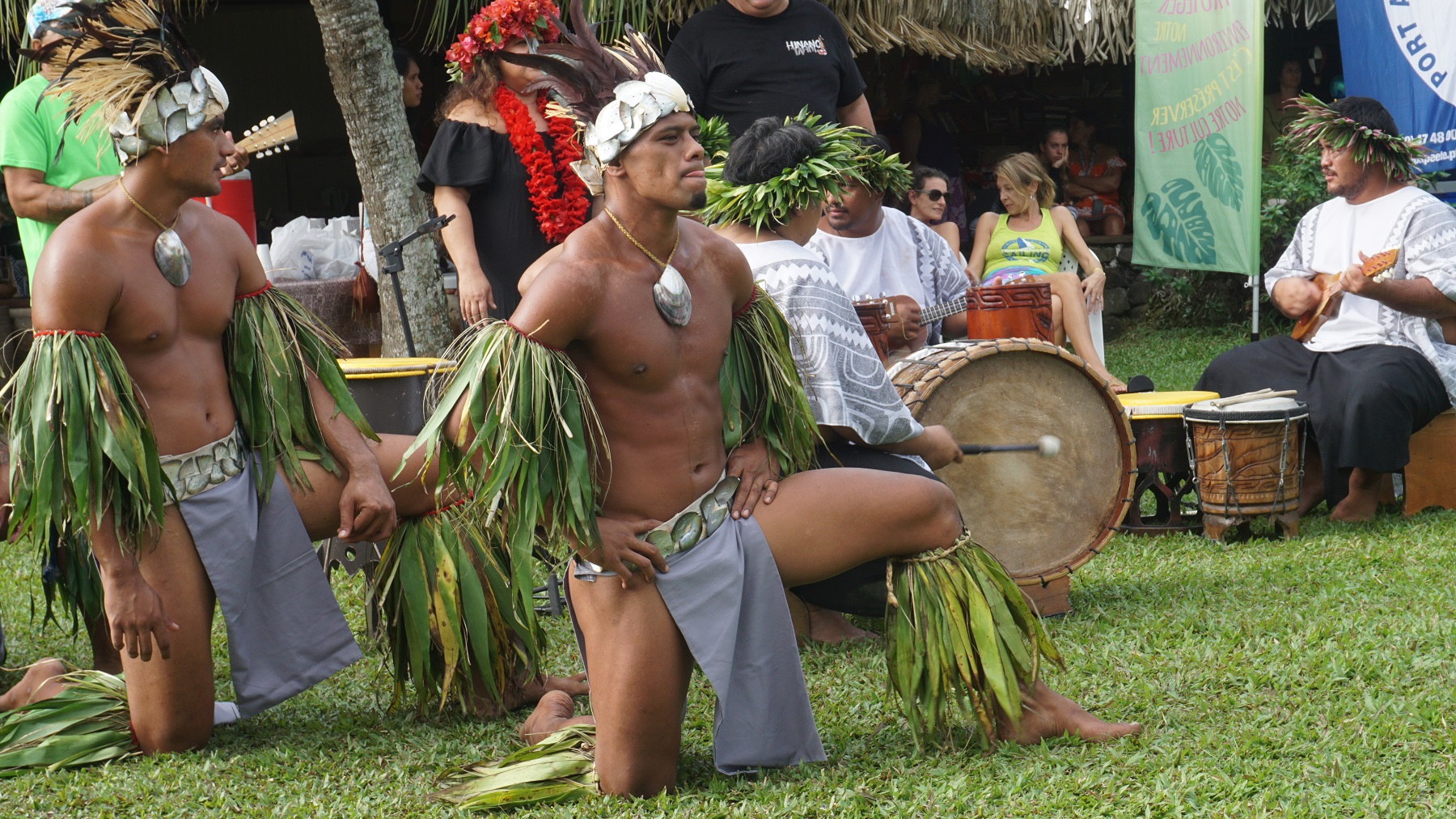
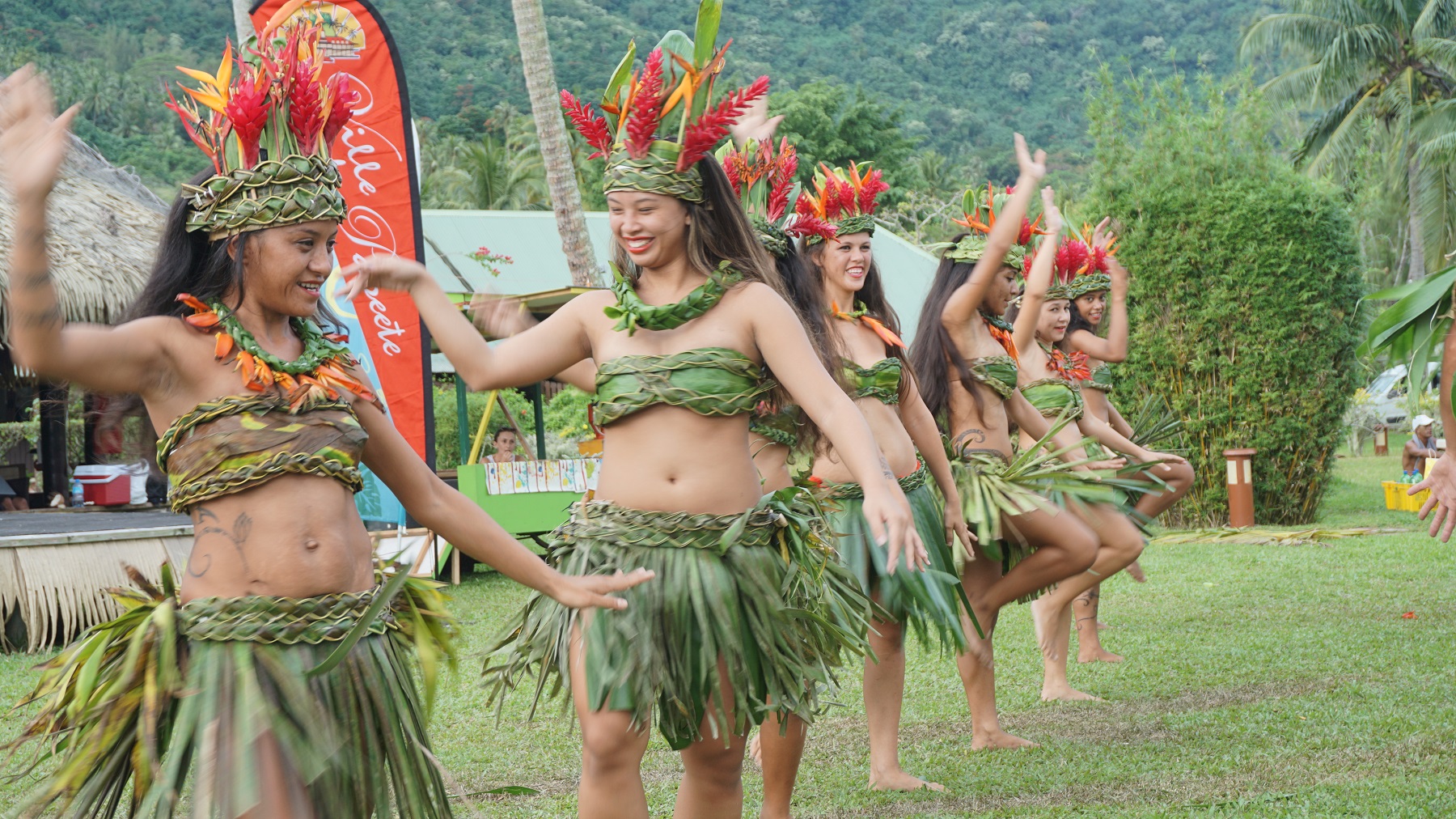
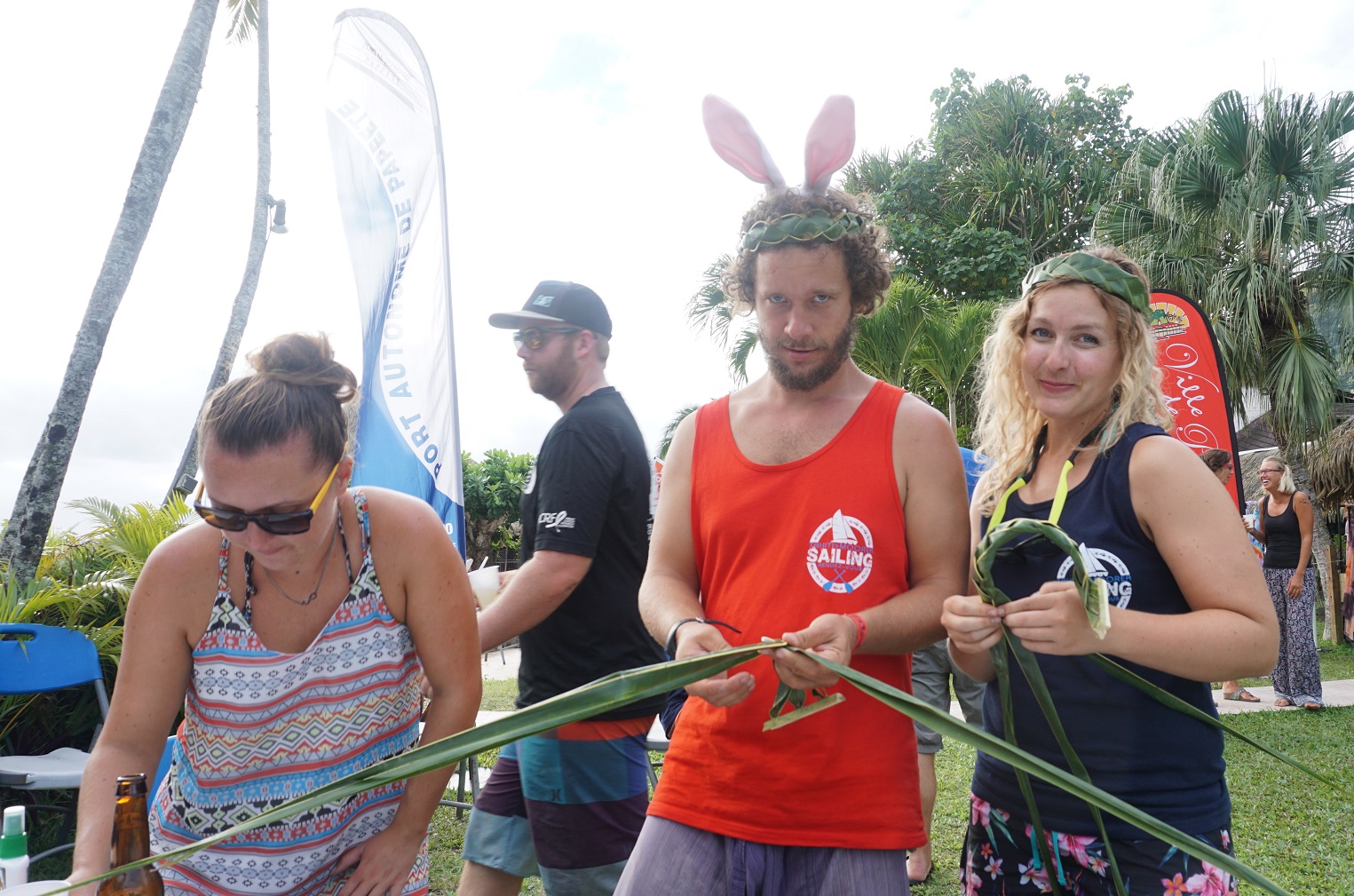
A full out-of-the-box “Tahitian experience” was prepared for us involving canoe racing, Tahitian dance, palm weaving, rock lifting and banana racing.  It felt nice to feel like a proper tourist after otherwise having been off the beaten track for a bit.  I felt guilty to be more interested in the company of other cruisers than that of the locals.  But as Ell has wisely pointed out, I was looking for connection, having put all my friendships on hold while I travel across the world.  I shared context with the other cruisers and they were part of my tribe.
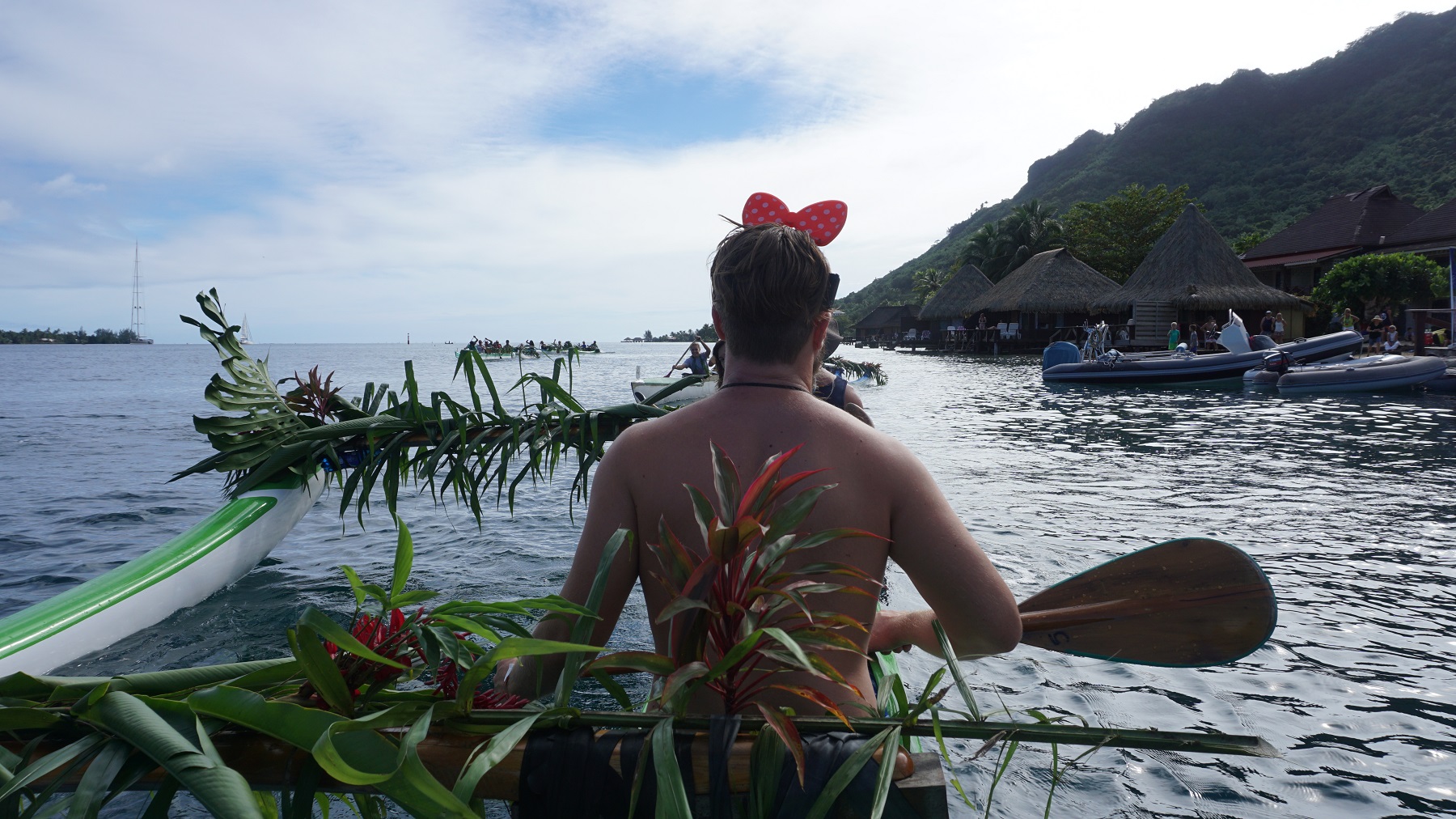
canoeing

male tahitian dancers tahitian dancers weaving

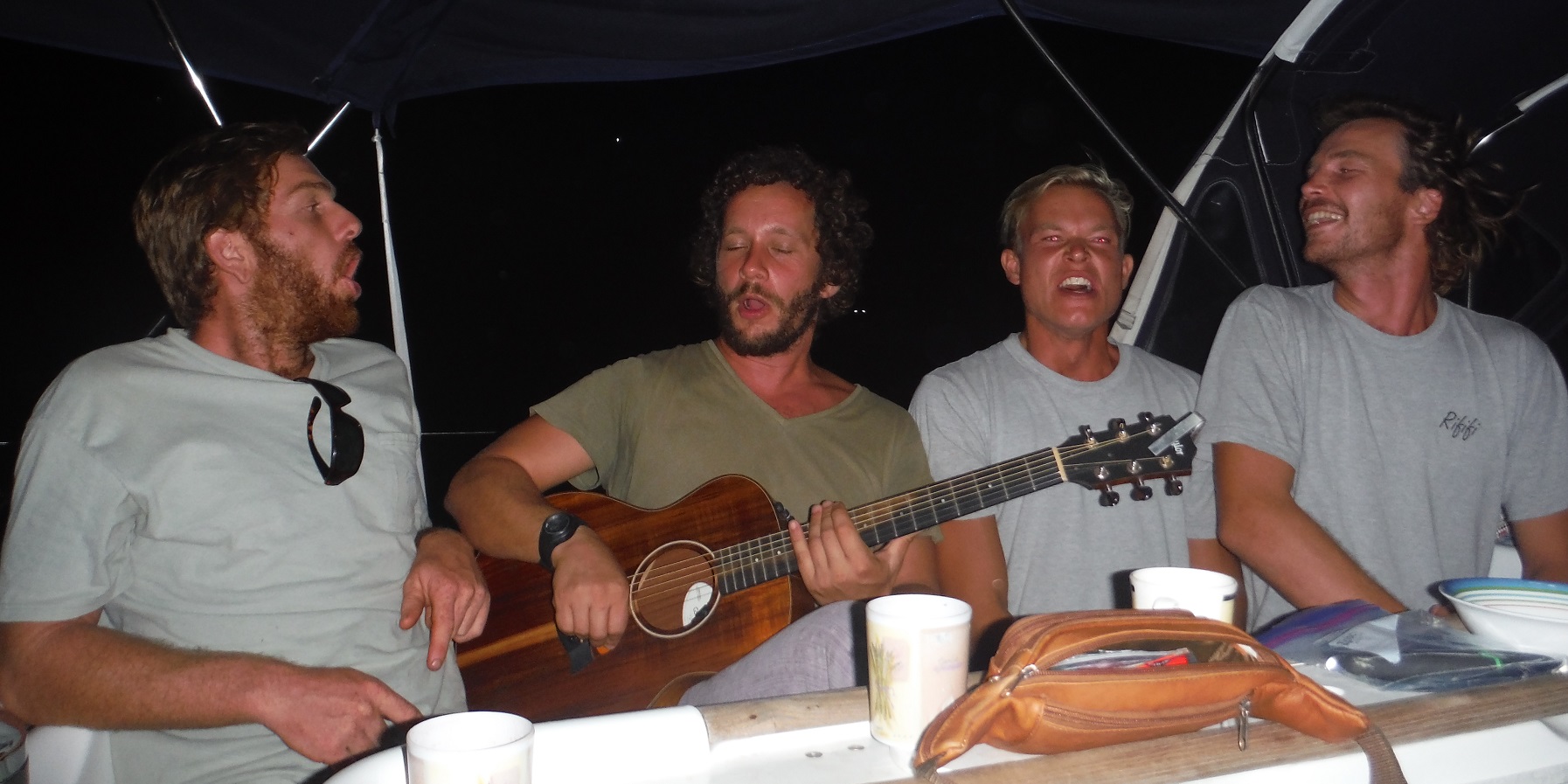
Much frivolity ensued.  Jandamarra hosted a jam party with a record number of 17 people fitting in its cockpit.

But my priority was not to see Tahiti and its islands, but to secure my place in the music course at JMC Academy in Melbourne.  They wanted two auditions, and I had just picked up the computer hardware to do a half decent job of it.  As John and Harry explored Moorea I set up a boat studio in the saloon while anchored in the bay.  I managed to borrow an electric guitar from Chris on SV Spill the Wine, and spent a full three days battling with technical issues, a noisy boat, a whirring wind generator, and other members of the crew who understandably wanted to be on the boat and make noise.  It has a distinct amateur flavour to it but then I am going to this college to learn something:

With so many boats in one place, all heading West, this was my chance to jump on another boat for the rest of the journey.  Keen to be clear and honest, I had already been frank with John about this.  Wanting clarity himself and, I think, happy with me in the current crew, he asked me my plans.  I told him I wanted to get to Brisbane for the 4th September.  Most boats traverse the Pacific aiming to arrive in a cyclone-safe port in Australia or New Zealand by the beginning of the cyclone season in November, but few look to arrive as early as September.

John agreed to the timeline, which was quite a big ask.  It is his boat, his experience of a lifetime, and his last stretch of freedom before returning to the hard slog.  It was now obvious that this was the boat that was going to take me all the way.  Crew dynamic was good, the boat itself was fast and spacious, and I had my own bed and bathroom, which is bloody rare.

The time came to pick up John’s girlfriend Sashi from the airport and give her a bit of a holiday.  I wasn’t too fond of Tahiti and wouldn’t otherwise have spent two weeks there – it was either grimy city or cardboard cut-out touristy.  After being on islands with just two inhabitants and snorkelling in a shark village, I would have much rather continue on and seen what the rest of the Pacific had to offer.  But this was my ride and I wouldn’t find another skipper that would make such a commitment.

Having managed to download the huge backing track file from Paul, I spent another day recording a one-take “live” version of My Island to use as the second track for the audition.  Undecided about whether to study Songwriting or Performance, singing an original song to a backing track satisfied the requirements of both.  Apart from a prolonged scratch of my dubious beard, I figured it was good enough.

I had also been asked, out of the blue, to write a radio jingle for a restaurant in Mallorca, where I had spent a month looking for an Atlantic crossing.  This turned out to be a much more prolonged process than I hoped – having started a couple of months earlier in Hiva Oa by sending them reggae, soul and funk ideas and now in Tahiti still refining the chosen reggae version into something by a white Englishman trying not to sound like a Pakistani.  Anyone who has heard me try to cover No Woman No Cry will know what I am talking about.  Although the hourly rate would probably put me under the minimum wage, I was lucky to have the opportunity so I put the hours in.  As I write it is in the final stages of production and will hit Mallorcan radio by the end of the year.  Bizarre.

We spent a little time down in Teahupoo, the famous surf break in Tahiti which holds a world championship every year.  Sashi, a Fijian Indian, made us ring-stinging curries every night and we dinghied out to watch the surfers on a wall of water crashing into razor sharp reef.

Our last stop in Tahiti was outside a petanque field.  Whilst provisioning we picked up some boules and joined in their Bastille Day tournament and got smashed out in the first round.  These guys were serious.  Theypicked up their boules with magnets and wore sweat-wicking technical T-shirts with petanque boules printed on them.  Can you even work up a sweat playing petanque?

Sashi’s last night was also John’s birthday.  I made John a killer chocolate cake and could see this made him quite emotional.  Score.
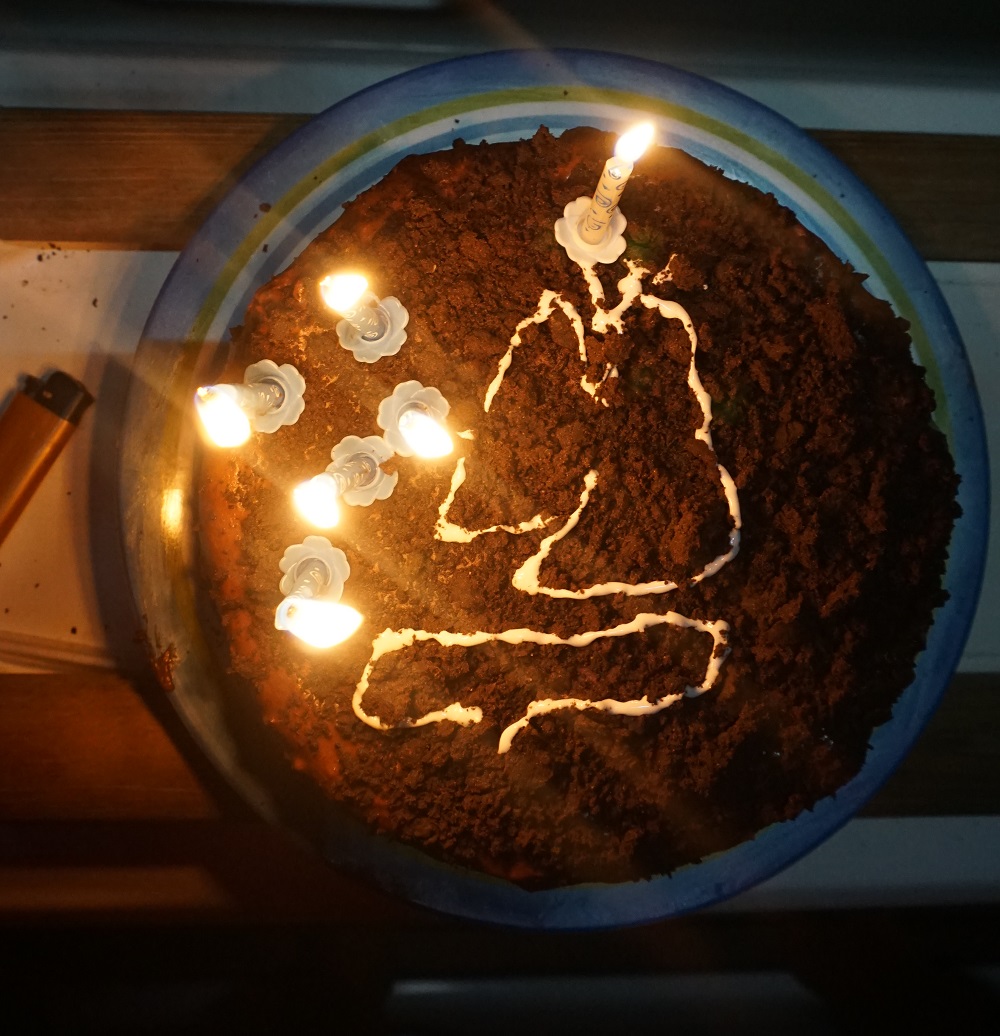
cake

In Tahiti we picked up Kat, a German girl looking to get to Bora Bora to work on a boat delivery to New Zealand.  By now I had written up a full itinerary that we all agreed to keep to.  On the day we were to leave, we also spoke with a Japanese girl, Mayo, who was looking to complete a flightless circumnavigation back to Japan and wanted to get a ride to Fiji.  But she wanted to leave the next day.  Begrudgingly we agreed – we wanted to help her out, and how could I impede someone which such a similar goal?  The next day she said she was going to wait out for a direct boat to Japan.  Needless to say I was very pissed off that we were now one day behind schedule before we had even left.  Sometimes kindness is not rewarded.  But most of the time it is.

Kat proved very useful in doing some boat jobs.  I shall not forget the german voice shouting “I need a hammer” from the top of the mast.  She was good company, and she made a tiramisu which was bloody nice.
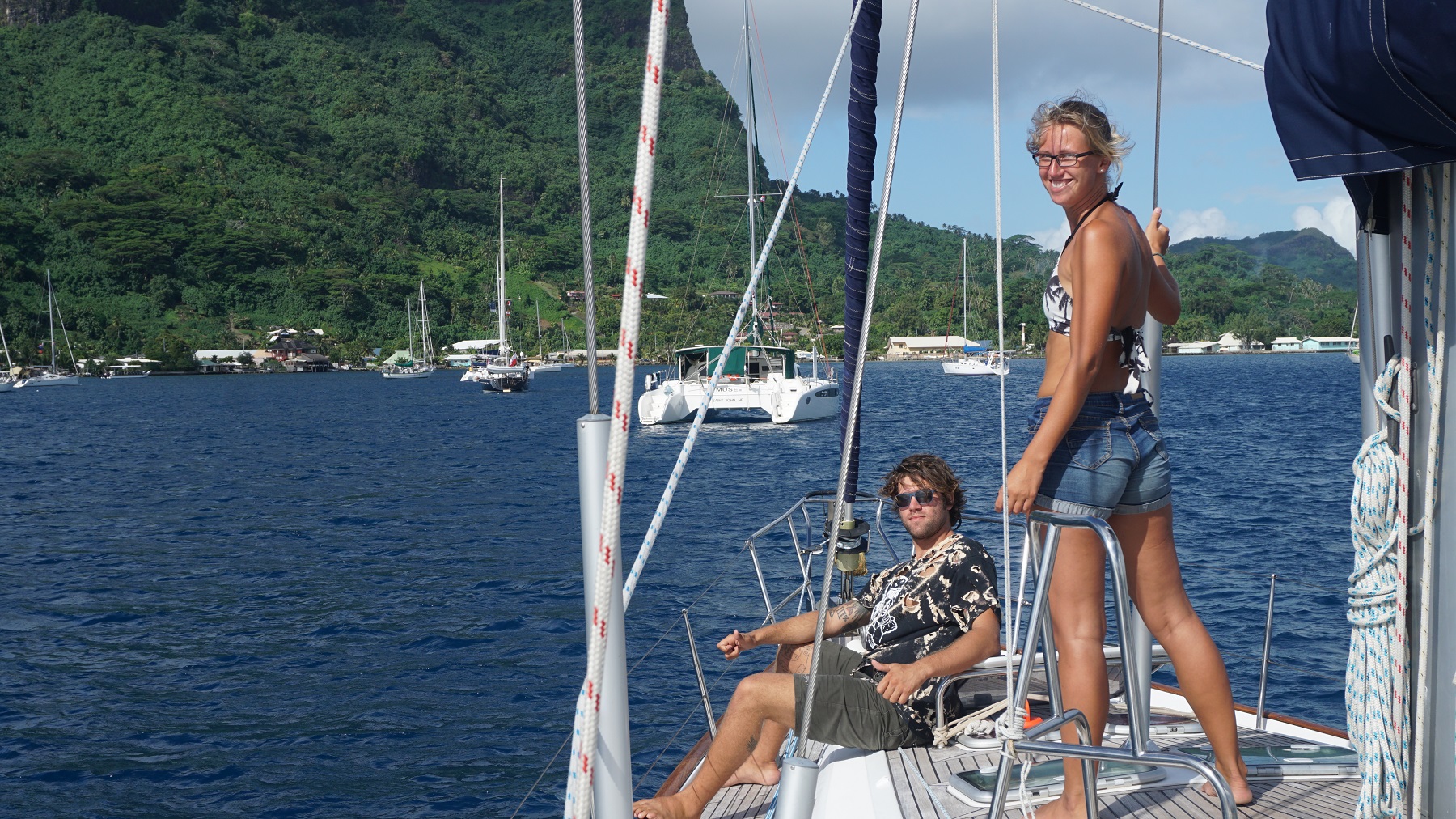
kat

Next stop Bora Bora.  My friend Ollie Badcock came here around 15 years ago and returned with stories of lagoons, sharks and manta rays.  It had filled me with envy but looked so remote on the map, I thought I would never reach it.


Open post

Goodbye Western Hemisphere

I write this at 4am in the morning, soon to be 3am tomorrow morning.  I think.  I am on night watch and we are just about to enter the Eastern Hemisphere, 180 degrees from Greenwich.  There is no ceremony of fish and slop like that on the superyacht half way across the Atlantic, or Prosecco as was cracked open crossing the Equator by the Galapagos.  This is actually even more arbitrary, but personally more important.  180 degrees from Greenwich means nothing until you consider that Greenwich is so close to my flat that my sextant is not precise enough to distinguish the 3 mile difference between the two locations.  I’d often run there, although always with the help of Google Maps.  Thankfully heading West with a bit of South in it for a few thousand miles is easier.

So this means, as Sam says in Lord of the Rings, I am the furthest away from home I have ever been.  And the furthest I will have ever been until I visit the place that scene was filmed.  All this way without a plane.  It doesn’t seem like much of an achievement when you consider that it has taken ten months and all of my money.  But I try not to think about that.

The miles from this point on will be a reminder of the decision to go this way round from the UK – through the Western Hemisphere.  I would have overshot Australia now by the same distance I am from it.  Every half mile now represents a whole mile extra that this decision has taken me.  At least, I think that’s right, more or less.

I began this journey looking to “feel the size of the Earth”, and you may laugh to hear me say that is indeed quite bloody big!  It has taken me twice as long as I expected but only given a little taste of the diversity of culture, geography, biology, pride and history that exists in the little isolation that can be found in this modern age.  Part of me wants to carry on, seek out new lifeforms, boldly go where no one has gone before.  The world is becoming more homogenised each day, from the culture to the language, food, buildings, technology, flora and fauna…  I want to see it all, aware of the irony that I become am an agent of the homogenisation by visiting.  I’m sure someone has written a song about that.  This urge to explore feels primal, and so strong I suspect it served an evolutionary function.

But stronger than this is looking forward to landing in Brisbane, settling down in Melbourne to a domesticated life with my girlfriend, enjoying knowing her and her knowing me, having close friends again, making new places familiar, focusing with longevity on music and discovering what is in me.  I have never looked forward to the future more eagerly.

So goodbye Western hemisphere, I am glad I chose you and I will see you again some day.

Open post

Sharks and boules

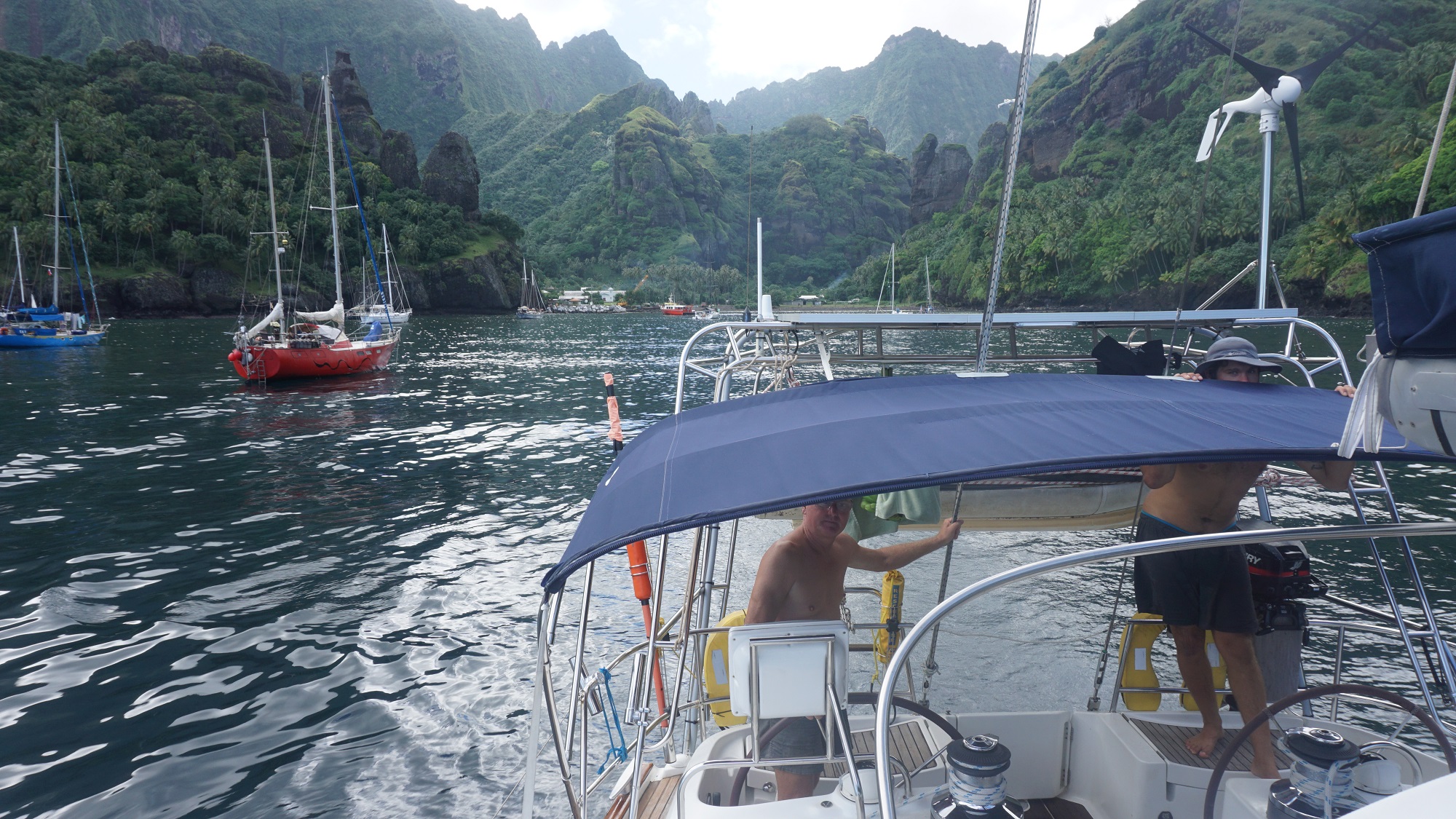
Formerly named “Bay of Dicks” after its imposing phallic rock formations, missionaries apparently took offence and renamed the “Baie de Verges” to “Baie de Vierges” – the Bay of Virgins.   Several sources had named this Marquesan anchorage one of the most beautiful in the world, so we could hardly miss it on the way out to the Tuomotus, 500 miles further westward.

It lived up to its name and fame, and we ventured ashore to trek up to the waterfall.  We climbed trees to fill our bags with pamplemousse (a local grapefruit) and cut off a bunch of bananas a metre long.

A few other cruisers visited our boat that night, beginning a theme of getting wildly drunk on rum, getting the guitar out and singing loudly into the night.  These ended up happening so often that I will probably stop mentioning them.

rum guitar

The following day we were on our first significant passage as a new crew, the 614 mile (534nm) trip to Fakarava, in the Tuomotus.

bay of virgins

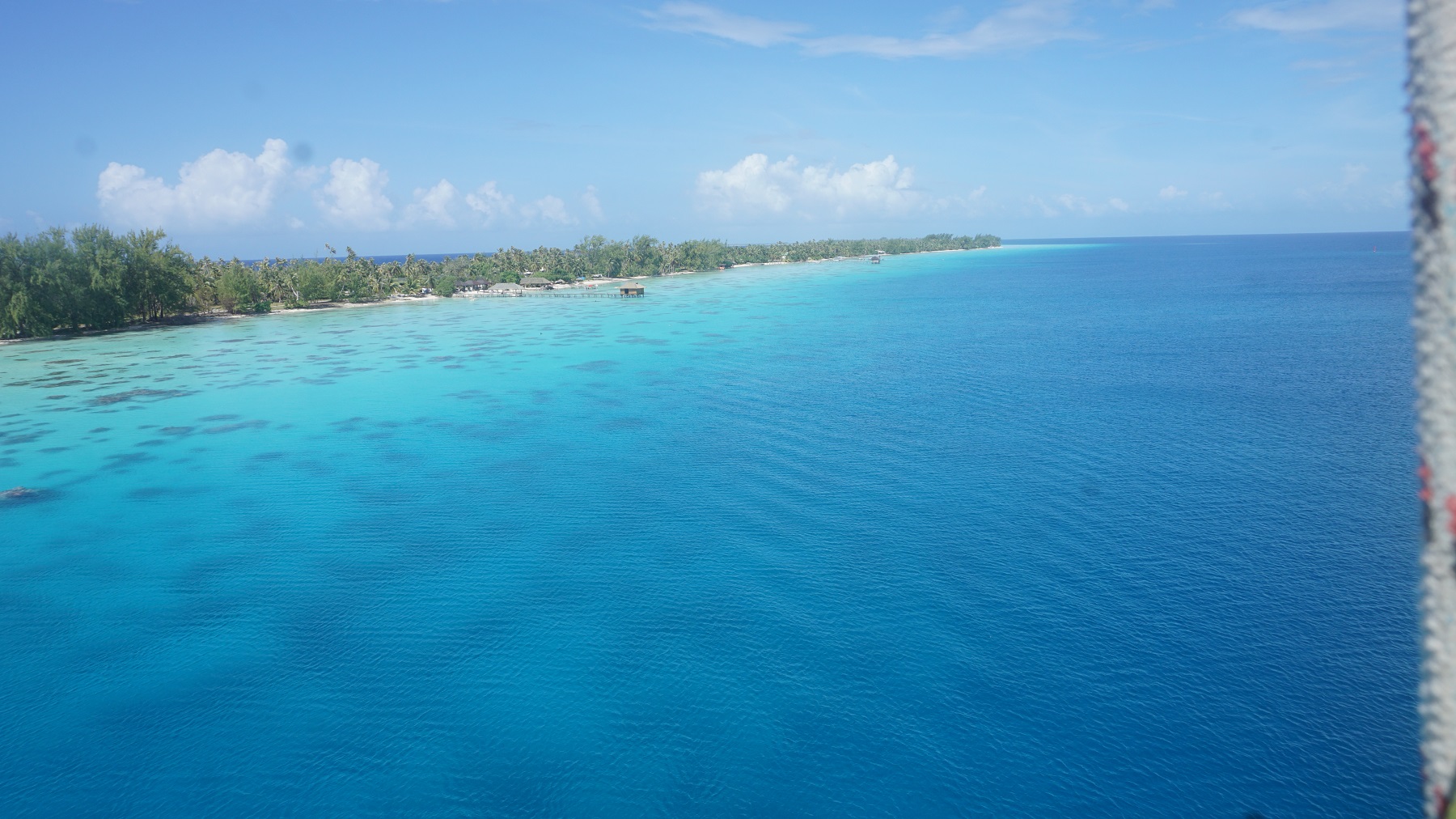
I’d suggested Fakarava to John and Harry because I wanted to snorkel with the hundreds of sharks that congregate there.  After four days at sea we arrived at the Northern end of Fakarava in order to transit through the lagoon to the shark filled waters.  Although the tide only rises and falls by 50cm each day, multiply that by the 290 square miles of lagoon and you get a lot of water coming in and out of a couple of gaps less than a mile wide.  The result was a hardworking engine and a boiling sea as thousands of tons of water fight against the persistent trade winds.

fakarava high

A quarter of a mile wide, the sea and wind ravaged iron shore east coast contrasts with the calm coconut-fringed white sand of the interior, where after just a few seconds glancing into the lagoon you’ll see the black tip of a reef shark peeking through the surface as it patrols the shoreline.

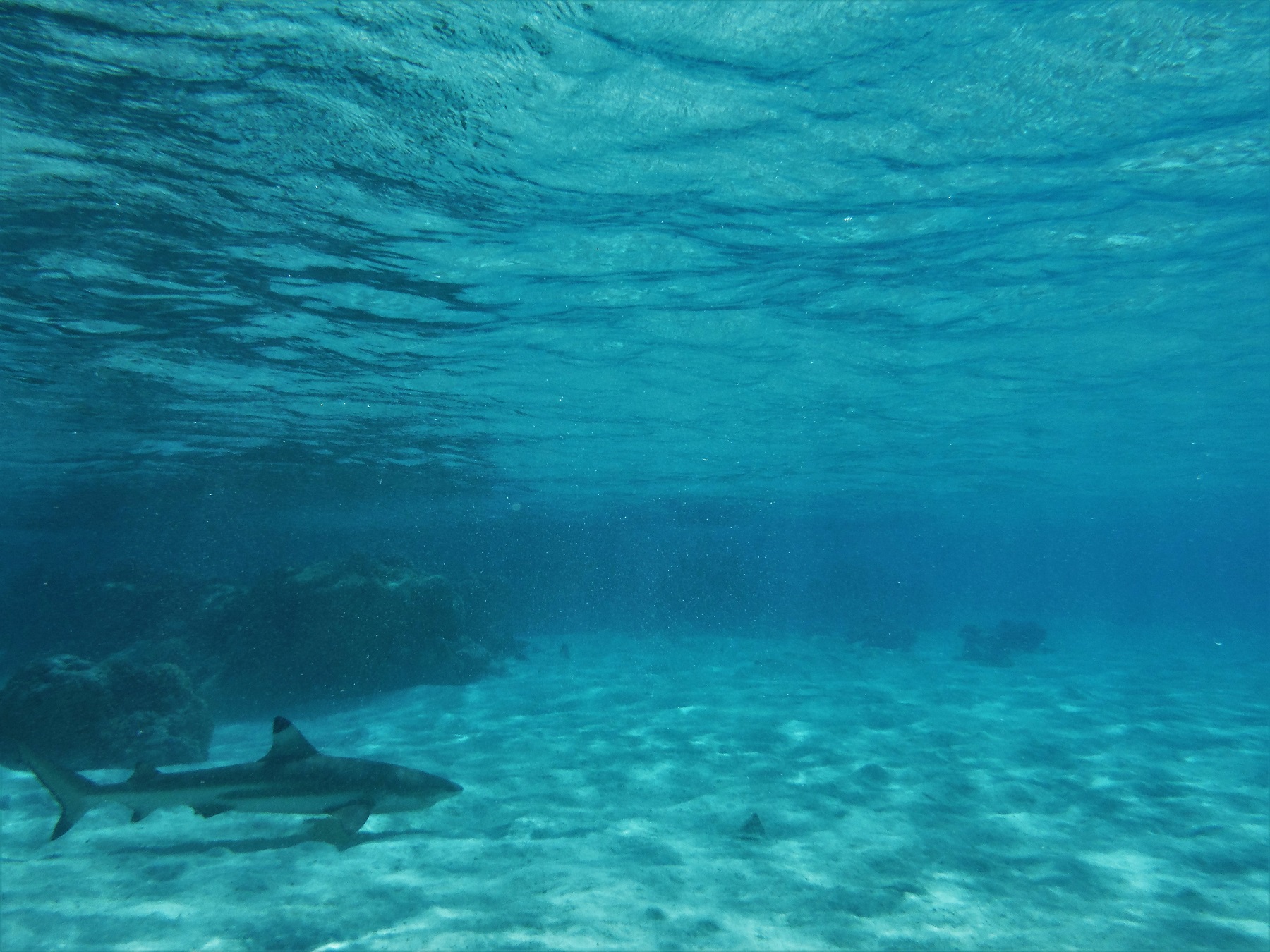
With no waves to object, Jandamarra glided to the South pass and anchored up for the evening.  The routine scraping of kitchen waste into the sea attracted some local reef fish which prompted six or seven sharks to investigate the back of the boat.  I donned my mask and snorkel and jumped in.  Even though I knew these were not going to bite me, I couldn’t resist the primal urge to get out of the water when a couple of them stared at me in the face and headed straight for me.  Tomorrow I would be braver, I told myself.  It’s funny how much safer you feel with other people in the water – I guess it splits your risk.

shark

The next day we got in the dinghy and headed to the south pass itself on an incoming tide, so we could glide back to the boat effortlessly with the current.  Literally hundreds of grey, black tipped and white tipped sharks hunted in the shallows or rested deeper down as the current flushed their gills with oxygenated water.  I watched scuba divers hiding behind rocks to catch a glimpse of them as we got just as good a view up on the surface for free.

Back at the boat John decided he wanted fish for dinner.  He grabbed his spear gun, jumped in, and quickly impaled a large parrotfish just a few metres from the boat.  Having been hit in the body, it didn’t die immediately, and it swam down under a rock, taking the spear, attached to the gun, held by John, with it.  In less than a minute, at least eight sharks had arrived and began to take chunks out of the wounded fish.  Limited by his breath, John came back up and waited for the sharks to calm down before retrieving his fishless gun.

Learning from John’s experience, Harry and I tried again.  After about half an hour of fish stalking (I’m sure those fish know what you’re up to), Harry got one, but again the fish ducked for cover.  I dived down and wriggled the spear free, fish attached, and the sharks were already after it.  I handed the spear to Harry, jumped on the dinghy and he passed the gun and fish up to me and quickly got in himself.  Triumphant, we returned to Jandamarra with a giant parrotfish.

Alas, after some online research we read that parrotfish in this area were a high risk of ciguatera, a neurotoxin that algae eaters accumulate, which causes a chronic illness to those who eat it.  We had to return the parrotfish to the sea.  It felt bad to have needlessly ended its life, but the sharks very quickly made use of the protein.

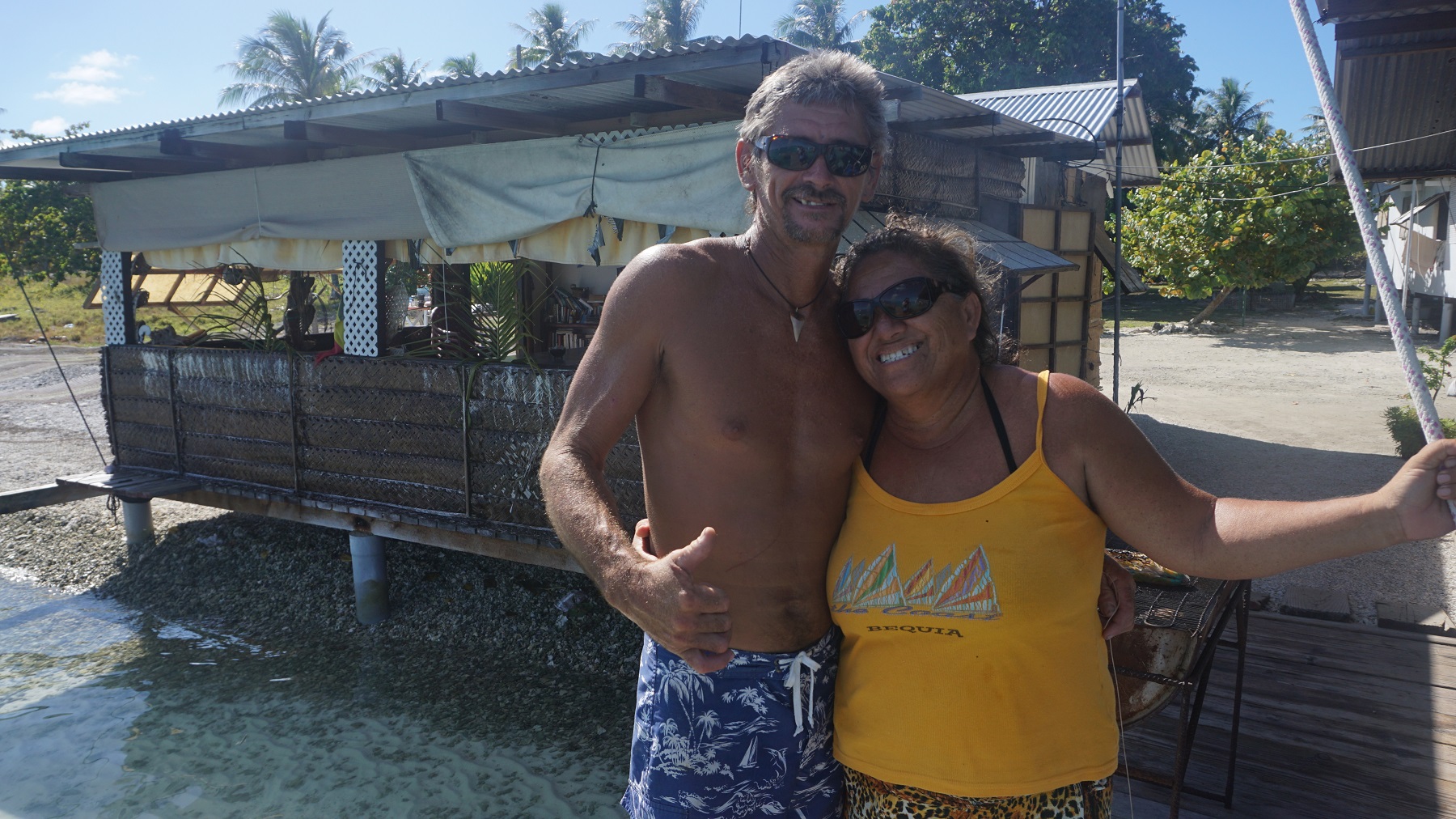
From there we navigated through the smaller South pass and 30 miles North to Anse Amyot in Toau, tying up to a mooring buoy owned by Gaston and Valentine, a Polynesian couple we had read about.  Dinghying ashore they made us immediately welcome with a beer and a game of boules (petanque).  Having played this as a child I thought I might have an advantage, but it turns out he Polynesians are very serious about their petanque.

gaston and valentine jpg

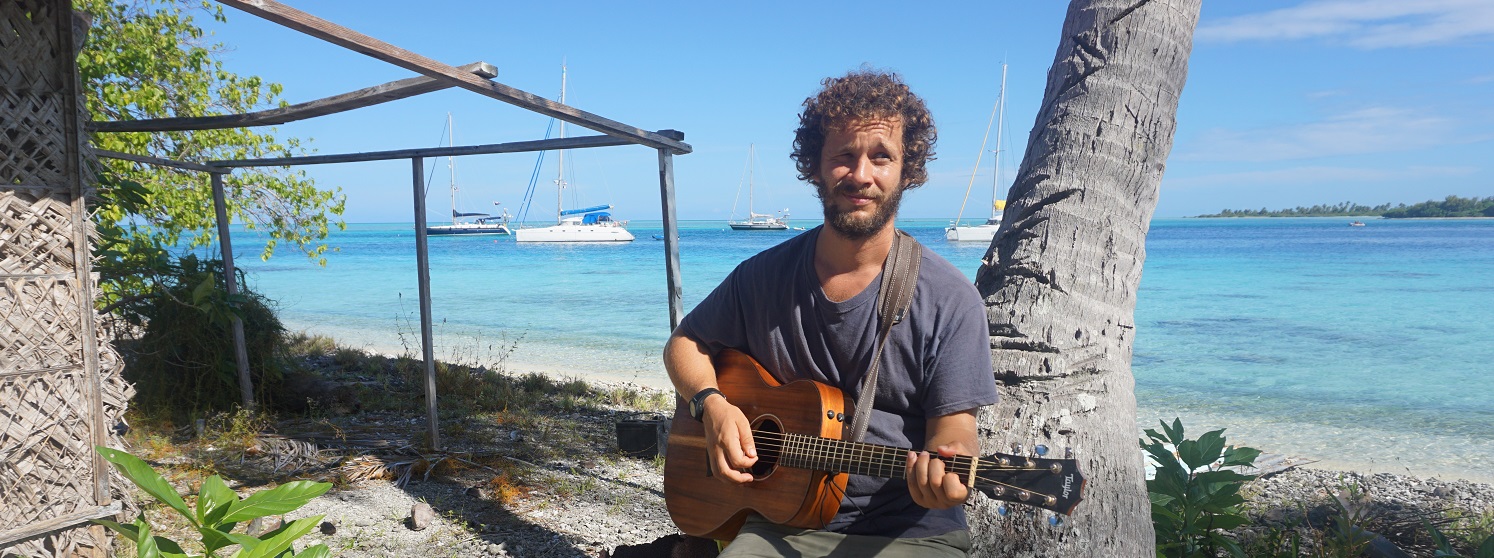
Day turned to night and we were invited for dinner, whereupon rum flowed and before long the guitars and ukulele were out and I was learning the chord patterns for all the Tuomotus music.  Which are all subtle variations of G, C and D.  But all the songs were so happy, they sang the words from the depths of their hearts, and we were accompanied by Gaston on his self-made dustbin bass, constructed from a plastic bucket, a stick and some nylon fishing net wire.  I want to make one.

dustbin bass

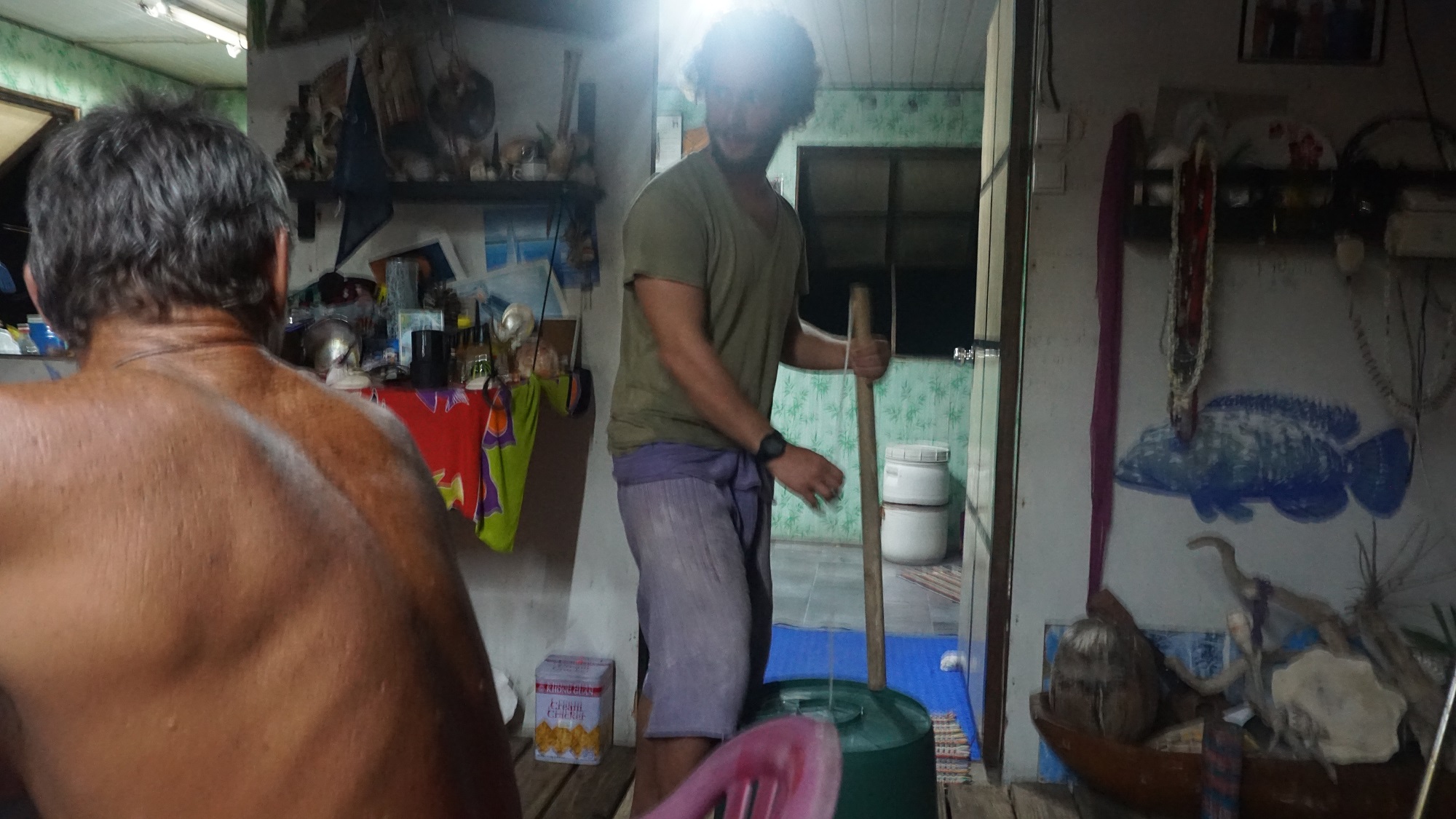
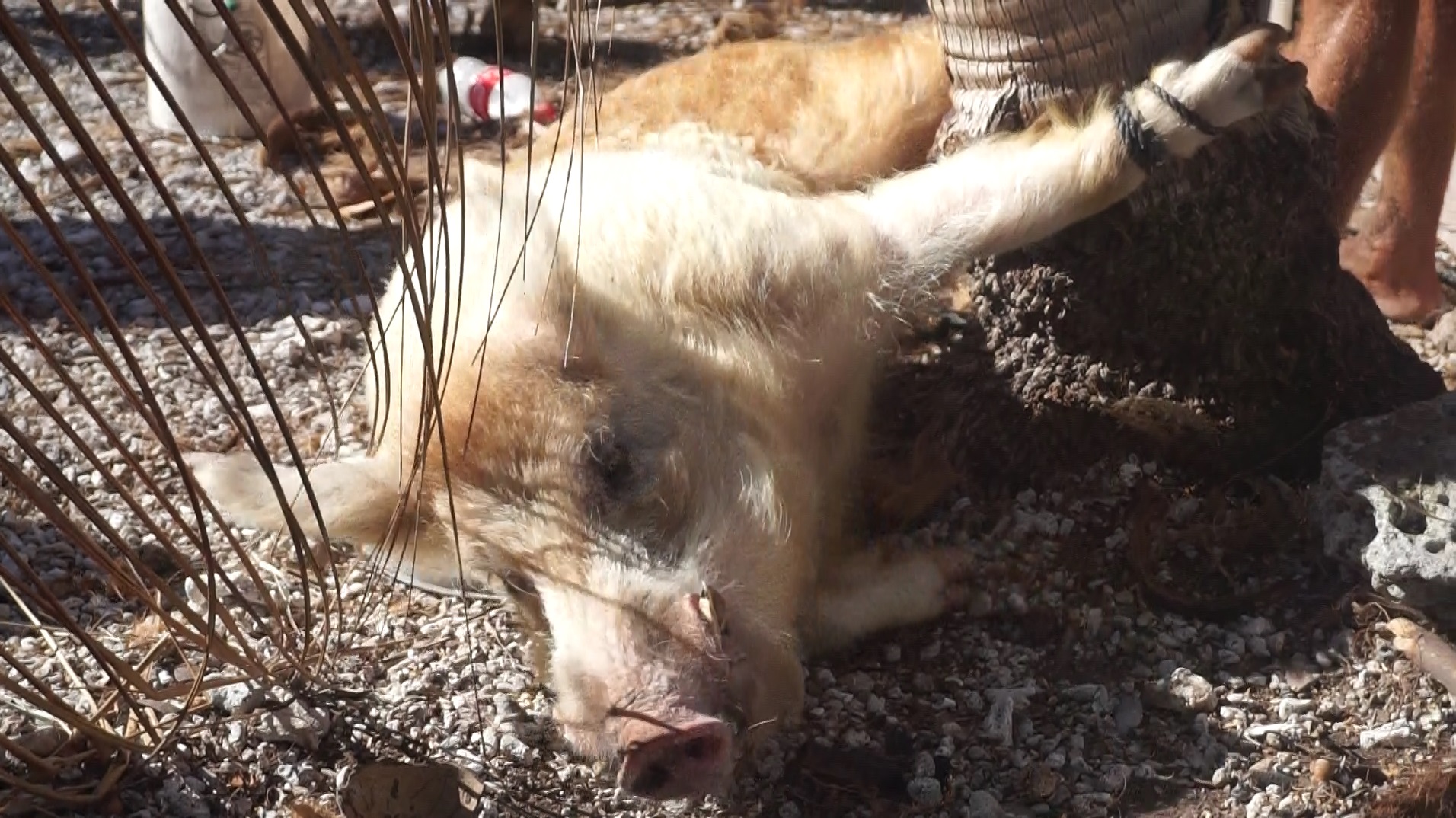
The next morning Gaston asked us to hold down his pig while he cut its balls off.  He said it had become too aggressive and this was a standard procedure.  I found myself holding onto a rope attached to its leg and lashing him around a tree.  Gaston then performed the surgery with great knowledge of the task and the pig’s anatomy.  I mindlessly videod it, and now can’t watch it – it is one of the most disturbing things I have seen in my apparently sheltered life.  The all male audience winced as testicles were twisted, cut, then the bits and bobs tied together and the cavity cleaned with lemon and salt.  The pig’s squeals will echo in our minds for a while.  Untied, defeated and ashamed, the pig walked away a different beast.

pig tied up

At lunch, a metal bowl was uncovered with some meat braised with some onions in a dark jus.  Surely not.  Bien sur!  It was un plat de boules.  The package had been dispatched to a cruiser from Reunion, who returned it as a French delicacy.  Of course we had to eat it.  I can’t say it tasted bad.  It was expertly prepared – very tender, as you’d imagine a pig’s dark meat to taste like if it was a turkey.  I wish I had enough control over my mind to nonchalantly munch on a pig’s bollock, but I didn’t.  I had two polite mouthfuls and unconvincingly protested that I was full – if only I hadn’t eaten so much pasta…  For the record, John and Harry both ate a plateful of the stuff.  Harry always needs to be the man, and John will just eat anything.  The meal concluded with more music and rum mixed with sugar into the night.  I am sure this is a very unhealthy way to drink rum.

The chores did not end there.  The next day would be a big feast so Gaston needed help with his fish traps.  That guy just did not stop.  Suffice to say that there is apparently no ciguatera problem with any of the fish – parrotfish were all on the menu.

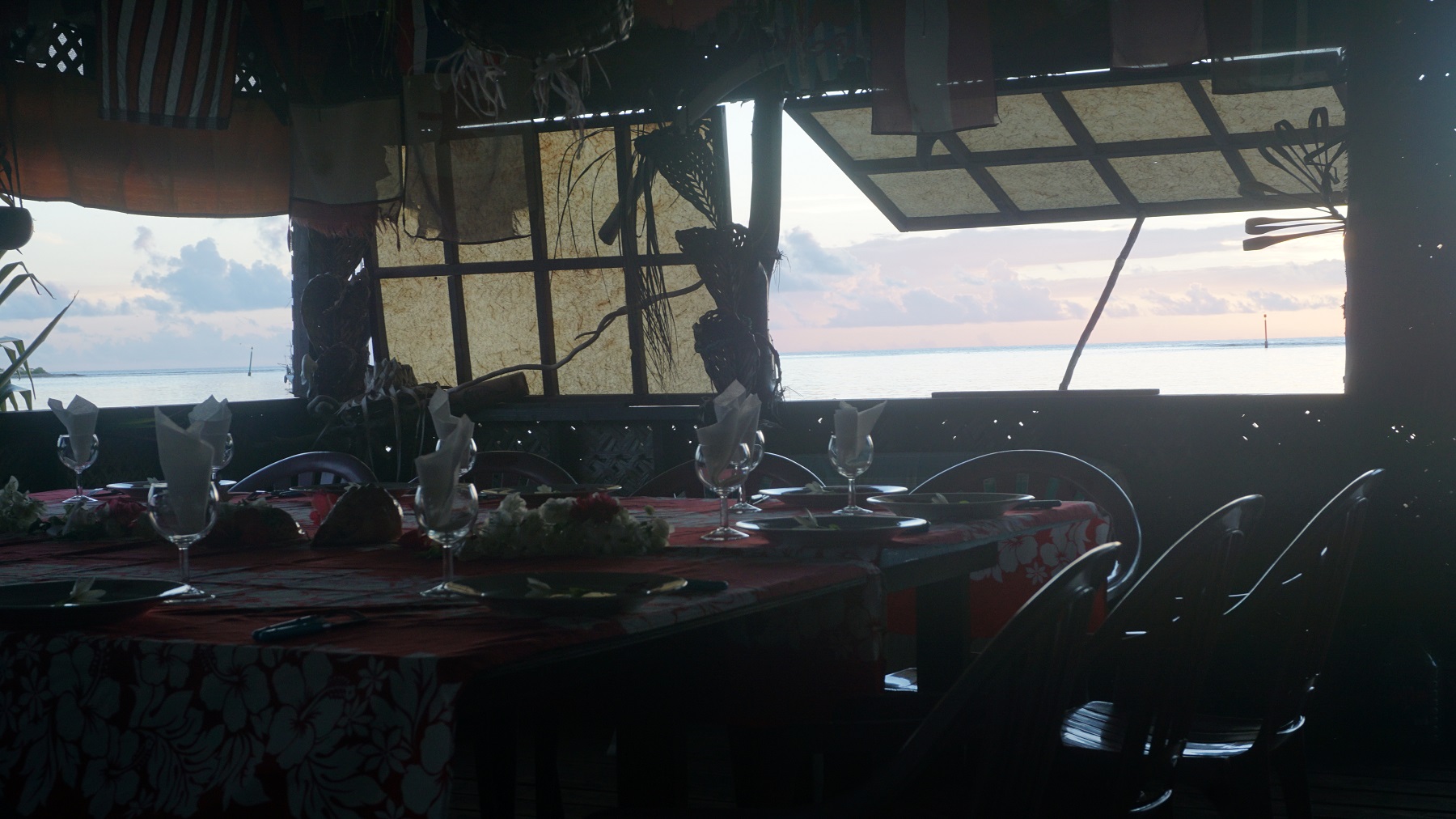
As darkness fell, lobsters from Gaston’s own trap were cut in half and still quivered with life on the barbecue.  The fish was chopped up and presented raw as “poission cru” in freshly milled coconut milk from their own coconut trees.

set table

A dozen or so cruisers attended, which at $30 a head is surely a big earner for Gaston and Valentine.  I was then wheeled out to accompany them on guitar as they entertained the crowd with some more G, C and D Tuomotus classics.  They kept me on my toes and surprised me with an Am at one point.

With French the common language in French Polynesia, you would expect us non French speakers to be ostracised but this was not so.  While Gaston and Valentine did speak fluent French like all Polynesians, their first language is Tahitian.  There is little love for France, as they were conducting nuclear tests in the area as recently as 1995, displacing people and prompting riots.

my island guitar

In Anse Amyot I also started to work on my auditions for music college, which was now going to be what I was going to be doing in Australia (I can’t get a working holiday visa anymore being over 31).  Thankfully singing “My Island” on the beach didn’t work out and I figured out a better way of doing it later.  But Gaston and Valentine were at about verse three of that song in terms of development – with us having donated them a ukulele tuner instead of “a stone that made fire and the sweetness of bees”.  John did ask me to play that song for them but of course they had no idea what it was about and we had to quickly return to happy ukulele G C and D songs soonafter.

The next day we had to leave.  We could have easily stayed weeks, their welcome was so enveloping.  But we had a schedule to keep.  We were looking to make the scheduled rendezvous in Tahiti of all the Pacific Puddle Jumpers – the loose group of cruisers who left the American continent in March/April.  I myself wanted to get there to see if any other Australia-bound boats needed crew.  But things were going well so far on Jandamarra  – I was starting to think this may be the boat to take me all the way.

It was sad to leave but you only get to see such places because you left the previous one.  So off we sailed – next destination would be Papeete, Tahiti.  A big city in comparison to where we had been for the last two months.

Open post

Time to stop and stare

“What is this world if, full of care, we have no time to stop and stare”?  My sister tells me that this poem by William Henry Davies was a favourite of my paternal grandfather.  And it came to me on arrival to Hiva Oa, French Polynesia after 40 days at sea, when I told Salty’s skipper that I was going to get off the boat there.

I started this mission in October, to get to Australia from the UK without flying.  The Pacific crossing was the part I was most looking forward to, with its thousands of islands so small and remote that they you can’t see them on the world map. French Polynesia alone is the size of Europe.  Would I get a chance to see these places again?  How could I truly absorb them, travelling across over just 8 weeks?  Did I want to do it with this same crew that I had been with for 40 days, on the same boat and have that be the breadth of my experience?  Not to mention that we were paying $15 a day in the knowledge that other crew were travelling for free.  In the bay we were anchored were another thirty or so boats of different shapes and sizes that had arrived from Panama, Mexico, California and South America.  Some of them even had dive tanks and compressors on board, a salivating prospect for the plethora of pristine dive sites that lay ahead.

We had just landed in the Marquesas, lush green volcanic islands populated by a proudly tattooed tribal people who were cannibals until surprisingly recently.  The Tuomotus lay ahead of that, known as the Dangerous Archipelago, low lying atolls made up of thousands of tiny islands (“motus”) surrounded by perilously shallow and sharp coral reefs, with world-class shark-dense diving.  Beyond that were the Society Islands, including the “Pearl of the Pacific” Bora Bora, middle aged volcanoes surrounded by lagoons made calm by a protective ring of coral reef on which thousands of years of organic material had composted to produce compact postcard paradises.

But for now I was in Hiva Oa, the first touch point after 40 days at sea.  A French territory, it was a quaint French village community nestled in a rugged green-on-black forested volcanic wilderness.  The post office was the only place with internet, baguettes were the only cheap thing to eat and everything closed for 2 hours over lunch and a half day on Friday.   As a European citizen, I could stay indefinitely and even work there and settle down (ahem).

That first night there happened to be a bbq jam session at a shack on the indescribably beautiful headland overlooking the bay, the perfect place to scope out boats looking for crew.  The first person I spoke to was a Danish chap called Chris and, fuelled by the first beers in 40 days, I flashed my random access memory into his face at about 40 words per second.

“Well you seem like a nice guy”, he said “I’m pretty sure you could come onto our boat”.

And so it was.  They even had dive gear on board.  The next morning my sore head awoke to Nick (crew of Jandamarra, another Australian boat we were friendly with) asking our skipper Geoff if he and his girlfriend could jump ship and join Salty.  It seemed crew changes after 4,000 miles at sea were common.  Now knowing that I would not be leaving Geoff in the lurch, I told him that I was going to jump ship too.  I confirmed with Chris that the offer was not a drunken one and was sleeping on their boat the next evening.

However, all was not straightforward.  The boat, Pelagos, had been taken out of the water due to rudder problems.  They had thought it would be a quick fix, but it turned out the repairs would require parts to be shipped in and they would be out of the water for at least three weeks.

Bugger.

I remained optimistic.  It wasn’t the worst place to be stuck.

hiva oa beach

I figured I would hang around, see if Pelagos got fixed, and absorb the Marquesan atmosphere and see if there were any catamarans with full diving gear and a crew spot going.

Meanwhile Harry, the third member of Salty’s crew, had also decided to leave, and he joined Jandamarra and sailed off to explore the Marquesan islands.

Three weeks passed as I lived on board Pelagos as it was propped up on land.  Even though we had to climb down a ladder and dredge across the muddy boatyard to shower or go to the toilet, and inspect and change the cockroach traps daily, I made some good friends in Chris and Anders, and it was good to explore the island and decompress after such a long boat trip.

It was also enlightening to meet all the different types of people doing this sort of thing.  Old couples, young couples, single-handers, lone wolves with crew…  Most intriguing were the families.  “Home” schooled, kids were not a barrier to their parents following this dream.  More than that, every child sailor I met was  confident, socially adept and intelligent, with exceptional cultural awareness and knowledge of the world.  One six year old expertly switched between French and English as she chatted with a multicultural audience. The catamaran Tanda Malaika and its crew of four kids and two parents were to become a feature at many stops across French Polynesia.  We sang, rapped and jammed on guitars and ukuleles and shared ice creams and crepes in Tahiti.  Finishing each other’s sentences and interrupting each other without frustration, they were a hive mind.  Various cruising parents told me of how the kids stop bickering when they get on a boat and turn into a crew.  It struck me that taking your child on a cruise around the world is not a selfish act that endangers them, but a gift of quality time with family and a character changing developmental gift from the school of the world.

Then the news came that it would be yet another three weeks before Pelagos would be ready to sail.  As alluring as the idea was of cruising a diving paradise with two young guys with diving gear (they were 20 and 21), it was time to cut my losses.  I emailed John, skipper of Jandamarra, to see if he would still have me.  Luckily he and Harry were keen and they sailed the 100 miles back against the wind to pick me up.

Jandamarra is named after an Aborigine warrior who led the resistance against the English.  And this machine battles the south seas well.  Just 4 foot longer than Salty, it* is nearly 50% faster, regularly touching 10 knots**.  Geoff would agree that it was a significant upgrade – the most exciting element being that I now had my own toilet.

I wasn’t sure if I was going to stay on Jandamarra.  John was a man of few words*** and I did worry about why his previous crew jumped off.  We had a frank conversation in which I committed to crewing until Tahiti – sharing expenses like food and diesel but with no daily fee.  After reprovisioning and a last drunken bbq, we set sail to Fatu Hiva’s Bay of Virgins.

I was back on the move again and it felt good.

* While it is conventional to refer to boats as feminine, I think this may be a patriarchal tradition we should eradicate.  Have you noticed how although we have no gender for most nouns, we refer to things as female that “Man” can or seeks to control?  It should only be allowed when impersonating a pirate.

** One of my father’s many casual strings to his bow is his qualification as a naval architect.  He still remembers the formula for calculating the “hull speed” of a vessel based on its length and I am sure it is only a matter of time before this appears in the comments below.

*** For an Australian

Open post

Saint Helena

My good friend Toby has told me I have become a little too brief and less of a story teller in these blogs. I thought I was saving you time. Well screw it, if you don’t have the time, don’t read it.
A Lonely Planet search for the top places in Costa Rica lists “Monteverde and Santa Elena” as a must see, but it didn’t prepare me for what was to happen over those two days.
I hired a car in Costa Rica, something I simply can’t believe I did as I look at my finances now! It is a beautiful fairytale world of endless green mountain vistas – much greener than Nicaragua, and overall better cared for. “Elevation”, my sister would call it – she loves elevation. My sister was on my mind because she was due to give birth in the next month or two, and missing it was one of the sacrifices I had chosen to make.


Monteverde had been founded in the 1950s, by a small group of Quakers that travelled down from the USA, pissed off with the way their country had militarised and in search of a peaceful retreat. The mountains of Costa Rica took their fancy, and the country had a cultural fit, having abolished its army in 1948. And so was founded the town of Monteverde. Ahead of their time, the Quakers recognised the importance and fragility of one of the world’s most diverse ecosystems, and set up the Monteverde Cloud Forest Reserve. It is the Reserve, as well as associated canopy tours etc that draws so many tourists from around the world each year. The tourists don’t seem to know about the Quakers – but the Quakers don’t mind.
My brother Sam is a Quaker, which gives me great pride. It is one thing to say that you are not going to inherit your parents’ religion, but quite another to choose another. But that is the way of the Quakers. They are a Christianity spin off, but perhaps their most characteristic idiom is “think it possible that you may be mistaken”. Nothing is ever really for sure. Sam likes that, and so do I. It seems patently obvious; the more specific you are about something, the more likely you are to be wrong. But that’s a conversation for another time.
Quaker meetings take place in a “Friends’ Meeting House”. I first experienced one when Sam asked me along to the Forest Hill Meeting House, because he was going to get married there and I was to be his best man. Sam told me that most of the meeting would be in silence, and people would stand up and say something if they felt moved to. I was a cynical stubborn atheist, but was surprised to find myself thinking that maybe these guys were on to something. Meek facilitators opened and closed the meeting, with a few Friends occasionally reflecting on something they felt moved to say.
Sam’s wedding ceremony took the same format, but was of course focused on the couple. Almost everyone there took the opportunity to stand up and say something, a story about how they knew the couple, or sage advice from those who had taken the journey. Some people planned their contributions, some didn’t. It was the best wedding ceremony I have ever attended (sorry everyone else).
Since then we’ve been treated to two “welcome meetings” for my two handsome nephews in the same format.
I planned my arrival in Monteverde for a Saturday, so I could attend their Sunday Meeting. As Cab Calloway said, “Jake, you get wise, you get to Church”.
When I arrived to wifi I discovered that my sister was going to give birth by C-section to a rather fragile child 2 months early, expected to weigh just 2lbs 10oz. Of course I had no real idea how small that was. She was expected to be in NICU (tubes and plastic box and the like) and there was a possibility she wouldn’t survive.
5 hours behind, when I woke up at 6am I exchanged some words on Facebook with Rachel who was waiting in the hospital to go in and be opened up. I drove to the cloud forest for a solitary walk. Surrounded by the sounds and sights of the jungle, my mind was on the moment, but couldn’t help reflecting on how Rachel and I had learned about mindfulness together.
A few hours later I was pulling up to the Meeting House. Even in the car park people smile to welcome you. The Meeting House was full of Quaker song, including one called “Simple Gifts” to the tune of “Lord of the Dance” which made me think of when my brother used to sing “Dance Settee” instead of “Dance, said he” cheekily at church.
Before long the song books were collected and the meeting fell into silence. For 50 minutes no one spoke. I closed my eyes and reflected on Rachel and Paul’s situation, and the guilt that I hadn’t made time to reflect on it before… Oh, how the mind is unkind! But it struck me that while the anticipation is often worse than the pain itself, the hard bit would be the uncertainty for Paul and Rachel afterwards. My Spanish teacher had told me the previous week of a friend who had given birth to a premature baby that died 40 days later. 40 days!
I didn’t go into the Meeting expecting to say anything – I thought I would just reflect and feel the warmth of the Meeting. But it crept up on me. I had to ask the Meeting to hold Rachel and Paul and the little one, in the light (whatever that really means – it is a Quaker expression). But 30 minutes had passed and no-one had spoken. In London they normally introduce the meeting, but no such introduction had been made. Would it be appropriate? I waited another 5 minutes, then another and another, until a lady stood up and made a short speech about “seeing what love will do”. She recounted all the recent events that gave her hope about their local community, and looked back to the first world war, referencing Luther Warren, a Quaker from her hometown Wilmington, USA who helped rebuild France following WWI. The entire thing was then expertly recited in Spanish by an elder at the centre of the room, even though everyone spoke English as their first language.
I left a moment of silence and stood up. “I’m Jack”, I said, already feeling the involuntary spasms in my diaphragm as my body trembled. I have no problem with public speaking but this was a completely different thing, probably because it wasn’t an act of any kind – it was the totally vulnerable truth. “I’m travelling across the world and I feel very lucky to be here with you, particularly today, as my sister is in hospital, having a Caesarean section. The baby is only expected to be 2lbs 10oz and I’d like to ask the Meeting to hold Rachel, her husband Paul, and the ninita in the light. May they have the strength and maintain the hope that they will need in the coming months”. As it was repeated in Spanish, the translator stuttered as she held back her own tears. Hearing it repeated back, I felt heard, and could feel my worry, sorrow and guilt instantly divided by the 50 or so people in the room.
As soon as she finished, two elders shook hands to signal the end of the meeting, causing a ripple of handshakes around the room. All visitors were then asked to introduce themselves. There were around 10 of us, from various Houses in the US and Canada. I owned up to not really being a Quaker but representing my brother from Forest Hill, South East London, and having enjoyed my brother’s wedding, niblings’ welcomings, and always appreciating the warmth and welcome of a Quaker Meeting House.
After the meeting, a guy with two hearing aids shouted at me very loudly from just a foot away “WHAT DID YOU SAY IN THE MEETING? I COULDN’T HEAR YOU!” His name was Paul Smith – I later found out he was a masterful cellist who wows audiences while not being able to even hear himself play. I explained the background, less peacefully than before. After being asked to leave the room, he told me that you are given gifts in life, and sometimes they work out and sometimes they don’t. It was simple but somehow wise and reassuring. While we were talking, many people interjected to say they would think of my sister. Incidentally no-one ever used the word “pray”. Praying was only mentioned later.
A lady beckoned me over and said she had to talk to me. She had been born here in Costa Rica – in the second generation of the Quaker community. She waited until we were alone in conversation and then said “your story struck a chord with me. We lost our first after a week. But it was a time of great love and great warmth, and I just had to tell you about it”.
She told me how there in Costa Rica her baby was premature, and needed a lot of help. She had tubes keeping her breathing and feeding her. “She couldn’t feel anything of the world, how can you feel anything of the world when all you can feel is those tubes down your throat?”. But, she said, she was inspired by her daughter’s strength. She was awed by the force that enabled her daughter to survive in those circumstances for as much as a week. As that week went on, and it became more apparent that her baby was not going to survive. Instead of feeling despair, she felt calm. It was a gift that this life had existed at all. She felt wonder, love and warmth building and building up to the moment that her daughter died. It was only later, when the commiseration cards came through, that she realised that people had been praying for her. And maybe, she implied, this was the warmth she felt.
We hugged in tears. Thinking about the worse case scenario, and grabbing for words of encouragement to offer my sister, I remembered that she said this was her “first” child and asked “You say you’ve gone on to have other children?” “People said that at the time”, she replied. “I know they were trying to comfort me, by saying I could have other children, but it just didn’t make any sense to me at all. Even today, I still have a connection with that child. I have three children – I just tell people I have two so that I don’t have to go through this whole story. And that is something I need you take away from this. It sounds like your sister’s baby is going to be fine, our daughter had so many failing systems. But if she doesn’t survive, your sister needs to know that her connection with her daughter will always be there.”
I thanked her, because I was thankful. Travelling on my own, I did feel distant from my sister in her time of need. The night before, I’d thought about telling my travelling companions about it but it didn’t feel right. The Meeting had given me an instant community that was sharing in this, an instant intimacy that wasn’t paranoidly judging itself, and this lady had so bravely gone out on a limb to tell me this vulnerable, intimate story in a hope to help me and my sister. It felt like it would be okay if my niece wasn’t going to make it – it was going to be okay.
I had to leave if I was going to make it to Volcan Arenal by dusk. I asked her name. “Elena”, she said.
Monteverde was the name of the area we were in, but the name of the town was Santa Elena, which means “Saint Elena”.
Dropping by my hotel, I got enough wifi to get a message from my mum that the baby had been delivered “crying”. I drove for 5 hours to Volcan Arenal, where I would next find out more.
Just as I was starting to feel upbeat about the situation, Spotify on shuffle played Foy Vance’s “Two Shades of Hope”:
“Some people think their sin

Caused the cancer that’s eating into them

And the only way they can win

Is by the healing of somebody’s hands on their skin

But when the cancer does not go

Baby, hope dealt the hardest blows
…

Yet I cannot help myself but hope”
Oh Foy. And it was Rachel who first explained to me the meaning of this song (I am a bit slow). It could have been death caused by dangerous crying. And by the way if you’ve never listened to Foy Vance I suggest you do.
When I got to my hostel, I logged in to find that all is well. The baby, Abbie Christine Charli West, was indeed 2lbs 10 oz, but did not need to be assisted in breathing and was being downgraded from NICU to HDU. Still not out of the woods but a bloody good sign. She was in the best UK hospital she could be, and as Rachel works there we think they may have pulled out the stops a little.
3 months on, Abbie is doing fine having doubled in weight and just spent the weekend at our local music festival. It hasn’t been the easiest time for Rachel and Paul, but it is nice to now just think of Abbie as a new life in the family, and not be dogged by impending catastrophe.
Even though all is well, I feel forever changed by that conversation with Elena (actually it’s Helena with a silent H but never let the truth get in the way of a good story). To genuinely see the magic in what you had, not the tragedy in its loss, is a lesson I hope to retain.

Open post

40 days and 40 nights

…and around lent too. How biblical. I don’t think I have ever given up so much for lent, which seems an apt theme to describe this journey of around 7,000km from Panama across the Pacific to here, Hiva Oa, French Polynesia.

Beer

Each of us have our alcohol dependencies, and for reasons of cost, safety and likelihood-to-have-a-breakdown-and-murder-each-other, we chose to leave the booze in Panama. Exceptions included a sneaky prosecco celebration on the equator and half way points, as well as when a guy called Barry on a catamaran passed us about 25 days into the trip and donated us half a tuna he had just caught and a litre of wine. We actually managed to get drunk on that, gleefully guzzling sashimi with wasabi and soy.

Internet

This had the biggest effect of all. We held conversations without flicking up that blue and white screen in lulls, having speculative discussions with no way to check the facts, like in the old days. Reading books, playing guitar, journalling, baking… All these things replaced the waste of time and harbinger of discontent that is Facebook scrolling. Although I am happy you found this blog… Everything in moderation of course.

Showering

The aptly named Sailing Vessel “Salty” has no water maker, unlike most other boats cruising this way. While we harvested rain water, we didn’t have enough for the luxury of personal hygiene. So wet wipes it was – it was like Glastonbury but much closer to a toilet all the time…

Fresh food

I can now tell you the shelf life of most fruits and vegetables! Without a freezer, we were tin fed vegetarians except when we had caught a fish, which was about half the time. We actually ate better than usual, with veggie chilli, fish and chips, Thai fish curry, fresh pizza and calzone, dorado masala and paratha, fisherman’s pie, sashimi, tuna steak… We must have got through hundreds of pounds worth of fish.

Sleep

Common sense and international law requires boats to keep a constant watch to avoid collision, but also watching out for storms and wind shifts etc. With 3 of us we took 3hrs each, meaning you were lucky to get 5hrs sleep in a row. Yes, I can hear the parents telling me that I don’t know I’m born, blah blah… I noticed how much sleep and hydration affect your mood.

Privacy

Salty is 46 feet long, by about 13 wide. There isn’t such a thing as your own space. But, those 3hrs in the middle of the night were just me, the stars and the sea, giving headspace I rarely get back on land.

Socialising

The others won’t mind me saying that you do want to speak to other people after that amount of time. You find yourself telling and hearing the same stories…

In exchange…

The trade off is worth it. I can see why a 72 year old I met this week is on his 4th single handed circumnavigation and hopes to be on the helm when his time comes.
The stars are an incomparably bright ceiling to your world, especially when you’re from London. You feel more connected to them as you ponder the Polynesians that used just stars and birds to navigate thousands of miles, the explorers making this trip centuries ago, or the planetary scale of the journey you’ve embarked upon.
But you don’t feel the distance, just the time. There is no changing scenery, you occupy the centre of a circle of water and it doesn’t feel like you are moving at all. And time to read a number of books, time to play guitar for three hours, time to just sit there and think about nothing in particular… It was a psychological test for the first half, in anticipation of the potential horrors lurking ahead. But most of all it was healing to be able to get away from the stresses of life that are mostly self imposed, and free up some time in my day and space in my head.
Halfway across the Pacific now, there are now just over seven million metres left to Brisbane. But in between are the wonders of the South Seas – French Polynesia, the Cook Islands, Tonga, Fiji and New Caledonia.

It’s 4100 miles to Hiva Oa…

…we’ve got a full tank of diesel, half a boat full of water, it’s not windy and we’re wearing sunglasses.  (Hit it)

If this has made its way to the blog, then I have successfully squeezed a little bit of internet from a mainland cell tower as we make our way to our last anchorage to clean the hull before we set off for the 15 week sail to Brisbane, via French Polynesia, Cook Islands, Samoa, Fiji and New Caledonia.

The boat

Salty is a 46 foot Bavaria, ten foot longer than the Bavaria 36 that I am used to sailing on.  It is very similar, just a lot roomier, and reassuringly has two toilets, solar panels and a big battery bank.

The skipper

Having bought Salty in Greece (because boats are cheaper there), 52 year old Australian chef/photographer Geoff is sailing it back to Australia.  He wants to go at a good pace as he too has a girlfriend waiting for him, as well as two daughters.  Geoff grew up commanding boats of all types in Sydney harbour, which is to be Salty’s permanent anchorage.

Harry

Harry is a 30 year old log cabin fabricator, proudly from Pitsburgh, which I hadn’t realised was the centre of the civilised universe with everything a person could possibly want.  Tomorrow’s 4,100 mile passage will be his first sailing experience, although he is smart and resourceful so we reckon he’s gonna be okay.

The route

We originally intended to go to the Galapagos, but high cruising costs, restrictions and bureaucracy make it prohibitively expensive for the short period we would be going for.  Ah well.  I’ll have to tick that item off another time.  Reading about the comparatively untouched off-the-beaten-track places we will hang our hats in French Polynesia, I am over it.

So our first leg will be Panama to Hiva Oa, French Polynesia, which is a journey of at least 4,100 nautical miles.  At 120 miles miles a day, that’s 34 days at sea without land.  Equivalent to 19% of the earth’s circumference, or just over a third of the entire voyage from London to Brisbane.  We won’t be going in a straight line, as it’s most efficient to head south west, south of the Galapagos, to pick up the Easterly trade winds that should then be our carriage all the way across the Pacific.  Those interested can look at windytv.com where you can see the band of very consistent winds coming from the east just south of the equator.  But you’ll also see large areas of no wind – we must be prepared for periods of days of no wind and no progress…  The current in that part of the world also happens to be going west so there’ll be a certain amount of drifting too.  Failing that, we have around 120hrs of fuel, which we can use a little of to find some wind.

If you’re ever wondering how we’re doing, you can always have a look at the tracker, which is here: https://share.delorme.com/GeoffWARD

After Hiva Oa I should be able to update you again. The plan is to visit a few islands in French Polynesia on the way through to Tahiti for the 25th May to pick up another crew member, before checking out of French Polynesia in Bora Bora.  After a little research, I think the landscape, marine life and friendly people are likely to make French Polynesia my new favourite place on earth.

French Polynesia is an overseas French territory, meaning that as an EU citizen I can be there for as long as I want! Geoff and Harry have had to hire an agent to manage their visa formalities.  Seriously, what the hell have we done voting to leave the EU?  I’m willing to bet there’s a direct correlation between those who travel and those who voted Remain.  Especially when you start looking at the exchange rate change which has probably swallowed a fifth of my funds.  I know that reasons for voting either way are as complex as they are varied, but all I can say is that it has been and will be bad for me, personally.

Following Bora Bora, we plan on visiting the Cook Islands, Samoa, Fiji, and New Caledonia before the final jump to Brisbane.  But apart from that eventual arrival in Brisbane, where my girlfriend, cousins, uncle and aunts all live, my mind is for now firmly on the passage ahead.

The day-to-day

The first week is likely to be a test of character, trying to find the wind to take us south.  But once we get to about 3 degrees South, the easterly winds should be so consistent that the sails may not need much adjustment for days on end. We’ll be keeping a constant watch – 2 x 3hr shifts and a 2hr shift every day – but other than cleaning and housekeeping, we’ll be unoccupied.  Having left the last Spanish speaking country on the journey (having just got the hang of it), I’ll try to resurrect the 7 years of French classes that I hope are sitting on a dusty shelf in my mind, having borrowed some audio lessons from a fellow sailor.  I’ve stocked up on books, including Kon-Tiki, which is about an anthropologist drifting this same route to French Polynesia in a balsa wood raft to prove that French Polynesia was originally populated by the Incas (took him 100 days).  Also Mutiny on the Bounty and the two sequels, which document a mutiny on board a British cargo vessel in the 18th century that takes place in the same area.  I’ve also downloaded a few hours of singing lessons and guitar lessons, so I hope to stop singing flat, master fingerpicking and learn all 18 minutes of Arlo Guthrie’s Alice’s Restaurant by the time I get to Brisbane.

Food and drink

This was a big learning curve – buying enough food for 5 weeks is both expensive and time consuming.  Aside from a couple of weeks of fresh food, we have many tins of food and jars of pasta sauce.  Hot dog sausages, baked beans, black beans, kidney beans, tinned tomatoes…  We heard that the best way was to plan our meals and figure out what ingredients we’d need.  But we settled for estimating how much of each thing we’d expect to eat in a week and multiply that by 3 then 10, to safely provision for 70 days instead of just 35.

On water, we have around 400l in the water tanks, and another 400l in 5l bottles stashed around the boat.  Geoff doesn’t have a water maker, which initially bothered me but I now see that we’d have had to buy all this water as a backup anyway.

All three of us like our booze a little too much, and we know we’d turn to drink when we are bored, so we’ve decided to be a completely dry boat when at sea.  Which I think is a bloody good decision.

So much more I could say – preparing for this trip over the last three weeks has taught me a great deal, and learning how effectively we have prepared will probably teach me a great deal more!  This first leg of the trip is a big step, and will test us all psychologically as we get fed up with the weather, isolation, food and, probably, each other at points.

Goodbye for now

For now I bid you farewell.  It will be good to have a forced internet detox.  It feels equal parts scary and exciting to be setting off, but I know that when we get there we will have gone practically half way.  The rest of the trip is basically island hopping to Brisbane.  But until then, this is likely to be the biggest challenge yet.

inReach message from GEOFF WARD

Just testing posting to the blog from the onboard satellite communicator. Only 160 characters! You can follow the boat on this URL

View the location or send a reply to GEOFF WARD: https://inreach.garmin.com/textmessage/txtmsg?extId=6ba2b2d3-8cf5-46c6-90cf-24472664a142&adr=postathingy%40thejacklewis.com

GEOFF WARD sent this message from: Lat 8.907799 Lon -79.525137

Do not reply directly to this message.

This message was sent to you using the inReach two-way satellite communicator with GPS. To learn more, visit http://explore.garmin.com/inreach.

Posts navigation

1 2 3
Scroll to top